Skip to content
24/7 Emergency drainage response 0161 282 8080
Manchester Blocked Drain Co
Manchester emergency drainage team

Local Drainage Services in Trafford

Local engineers available across Trafford and surrounding areas for urgent and planned drainage work.

  • Fast local response across Manchester
  • Fixed prices agreed before work starts
  • No call-out fee
  • 24/7 emergency availability

Trusted by local homeowners, landlords, and businesses

Same-day slots Fully insured Modern equipment Clear reports

Fast callback

Request your free quote

Tell us what is blocked and we will confirm the next available engineer.

24/7 Emergency Response
Fixed Pricing
Local Manchester Engineers
No Call-Out Fee

Local response in Trafford

We attend homes and businesses across Trafford with rapid callout availability and clear fixed pricing.

  • Typical urgent response target: same day
  • Common callouts: blocked sinks, toilets, and outside drains
  • Coverage includes nearby neighbourhoods and links roads

Where we cover in Trafford

Drainage in Trafford

Trafford is a Metropolitan Borough spanning a wide arc from Old Trafford and Stretford in the north to Altrincham, Bowdon, and Hale in the south. This geographical spread means the borough contains some of the most contrasting drainage environments in Greater Manchester — from dense Victorian terraced housing in Stretford and Urmston to Edwardian and interwar semi-detached properties in Sale and Timperley, and the more prestigious detached housing of Bowdon and Hale.

The northern part of the borough — Stretford, Old Trafford, and Urmston — contains the oldest housing stock, with Victorian terraces dating from the 1870s through to the early 1900s. The clay drainage beneath these streets is typically 110 to 140 years old, and the combination of age, fat accumulation from kitchen waste, and the natural settlement of the low-lying Mersey flood plain creates regular maintenance requirements. Urmston and Davyhulme sit on relatively flat ground close to the River Mersey, and properties in these areas can experience elevated groundwater during prolonged wet weather.

The Bridgewater Canal runs through the heart of Trafford from Stretford to Sale and Altrincham, and the corridor alongside the canal can have elevated water table conditions. Properties backing onto or near the canal towpath in Sale and Stretford should be aware of this groundwater influence. The canal is managed at relatively constant levels, but heavy rainfall across its wide catchment can raise conditions along its route.

Sale and Timperley, developed largely between the 1920s and 1950s, feature semi-detached housing with clay or early concrete drainage now 60 to 100 years old. Tree root intrusion is increasingly common in these established suburban streets as garden planting from the original development era has now reached maturity. The roots of the large ornamental and fruit trees characteristic of 1930s and 1940s gardens actively seek out aging clay pipe joints.

Altrincham and Bowdon in the south of the borough contain some of the most expensive residential property in Greater Manchester. The Victorian and Edwardian houses in these areas were built to a high specification, but their drainage systems are nonetheless approaching or exceeding 100 years of service. The established gardens common to these affluent properties mean tree root intrusion is among the most frequent drainage complaints. Hale and Bowdon's elevated position on the Cheshire sandstone edge provides natural drainage gradients, but the depth of the sandy topsoil means root systems develop extensively and spread widely.

Our engineers work regularly throughout Trafford, from the Victorian terraces of Stretford and Urmston to the affluent detached properties of Altrincham and Bowdon, understanding the distinct drainage character of each part of this varied borough.

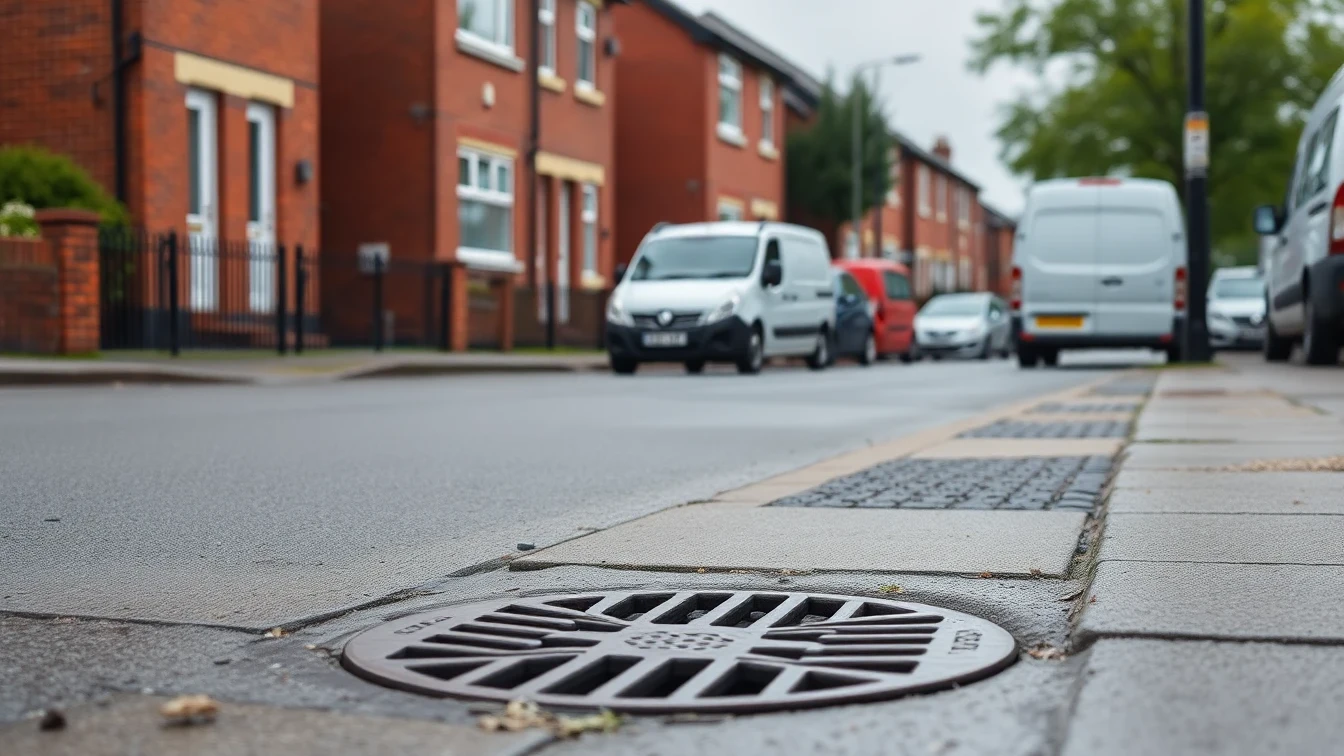
Areas and landmarks we serve near Trafford

Old Trafford StadiumTrafford CentreSale Water ParkBridgewater CanalStretford ArndaleAltrincham MarketUrmston town centrePartingtonTimperleyBowdonHale villageDavyhulme

Recent case study in Trafford

Call-out to a 1930s semi in Sale: the homeowner had experienced slow drainage from both the kitchen and the downstairs bathroom for several months, with rodding providing only a week or two of relief before symptoms returned. Our CCTV survey found the main clay drain running beneath the rear garden had been extensively colonised by roots from a large apple tree close to the boundary — root mass occupied roughly 60% of the pipe bore at the worst point. The survey also showed two significant joint gaps that had allowed the root intrusion and were accumulating debris. We used high-pressure jetting to thoroughly clear the root mass, then installed structural pipe relining throughout the 14-metre affected section. Result: blockage cycle ended completely, and the new liner sealed all joints against future root entry. The apple tree remained in situ. Tip: Sale and Timperley homeowners with established fruit trees or large ornamental shrubs near drain runs should schedule a CCTV check every two to three years — root intrusion caught early is far cheaper to manage than a complete blockage or collapsed joint.

Trafford drainage FAQs

Does the River Mersey flooding affect drainage in Urmston and Stretford?

Properties in low-lying parts of Urmston, Davyhulme, and Stretford sit on the Mersey flood plain and can be affected by elevated groundwater and drainage backup when the river runs high after sustained rainfall. The Environment Agency maintains flood risk maps for the Mersey catchment, and properties in designated flood zones should consider non-return valves on main drain connections as standard protection. Keeping gutters, downpipes, and surface gullies clear is particularly important in these areas.

What drainage issues are most common in Sale and Timperley's interwar housing?

The 1930s and 1940s semi-detached houses that dominate Sale and Timperley typically have clay drainage that is now 75 to 90 years old. The main issues are tree root intrusion through deteriorated joints — the mature ornamental trees in gardens from this era have extensive root systems — and joint deterioration that allows groundwater ingress and creates partial blockages. Annual jetting prevents fat and root material building to a full blockage; pipe relining addresses joint deterioration permanently.

Are older properties in Altrincham and Bowdon more susceptible to root intrusion?

Yes. The large established gardens typical of Altrincham, Bowdon, and Hale properties contain mature trees and shrubs with root systems that have had decades to extend toward drainage infrastructure. Victorian and Edwardian clay pipes under these properties have joints that have dried and gapped over the years, and roots are drawn to the moisture inside. We regularly manage root intrusion in these postcodes. Pipe relining creates a seamless internal barrier that roots cannot penetrate, making it the definitive long-term solution.

Call now Get quote